We did it! Jess Riddle and I, with the superb help of Dan Bryson
of Great
Smoky Mountains National Park (GSMNP) and Appalachian Arborists
employee Will
Crow wrapped up the final climbs and plots of the Tsuga Search
Project in
the southern Appalachians. We spent three days in upper Caldwell
Fork,
Cataloochee-GSMNP to measure and survey vegetation around four
trees Jess and
I had scouted previously.
Here is a day by day report:
July 24th
The early drive to the park was in light rain, an unwelcome
feature of the
day that would end up staying with us nearly the entire trip. We
hiked five
miles up the Caldwell Fork Trail to the (now closed due to the
bears we
reported on) campsite on Caldwell Fork. From here we went
off-trail up
Caldwell Fork to the vicinity of the "Caldwell
Colossus", one of the giant
hemlocks in the area also in the Tsuga Search Project. The wet
forest, soggy
soils, steep slopes, Rhododendron and heavy packs made travel
exhausting. We
found a relatively flat base camp among soggy moss,
Rhododendron, and
dripping dog-hobble. After setting up camp and hanging food we
continued up
stream with somewhat lighter packs to climb the "Colleague
Hemlock". The
Rhododendron was THICK, wet and dirty but we made it to the tree
just in
time for another rain shower. We covered the gear with a tarp
and waited it
out for a bit. Although this plot was blissfully free of dense
Rhododendron,
stinging nettle voraciously took its place as a plant to contend
with. The
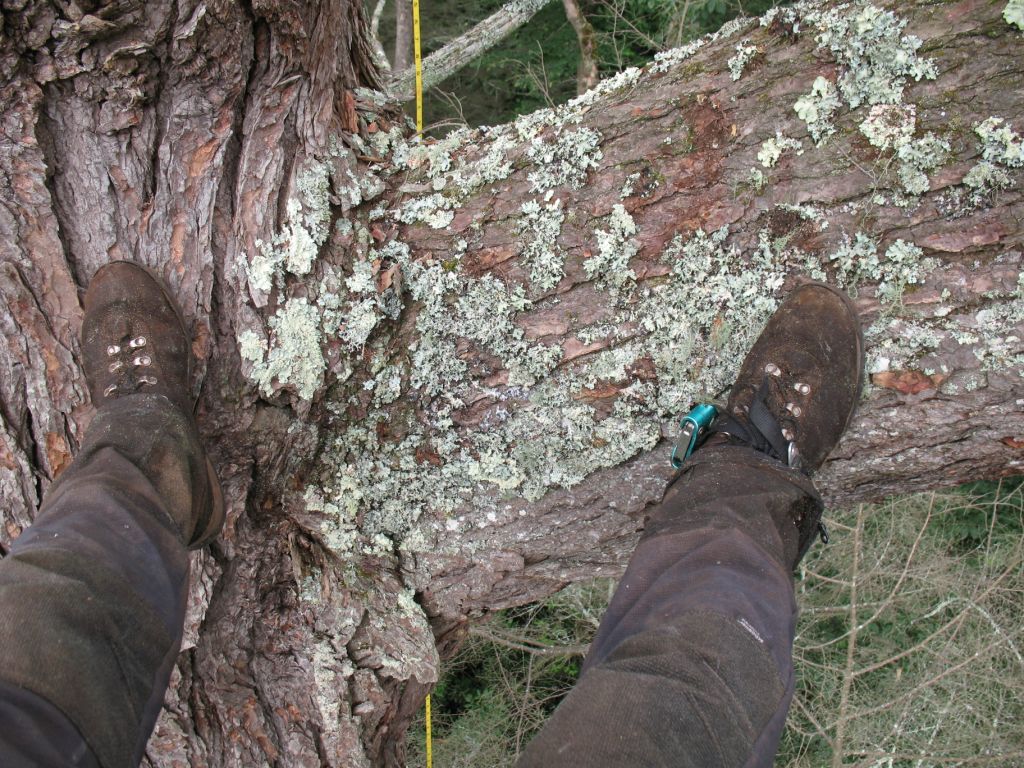
rain slackened and I set the climbing rope and ascended the tree
while the
others began the tree plots.
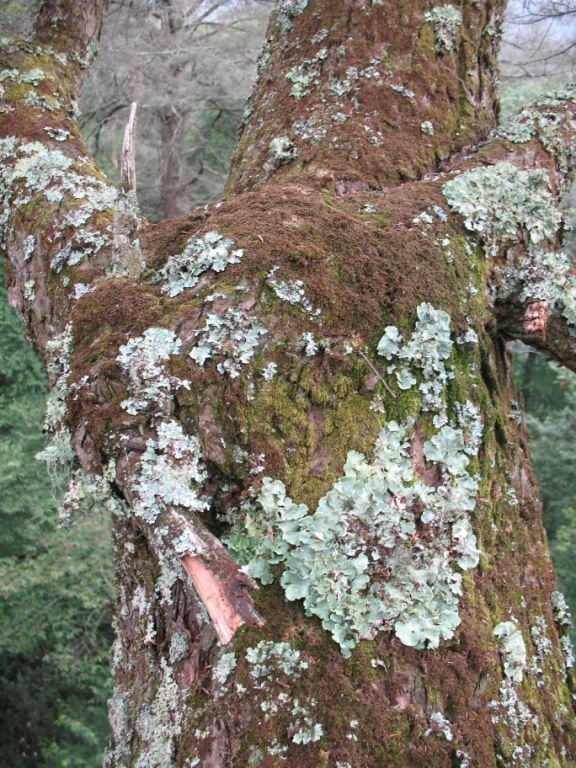
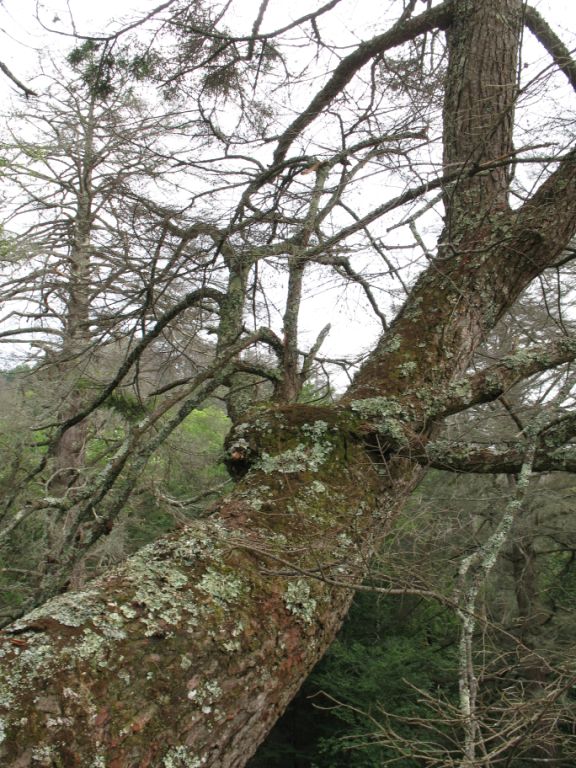
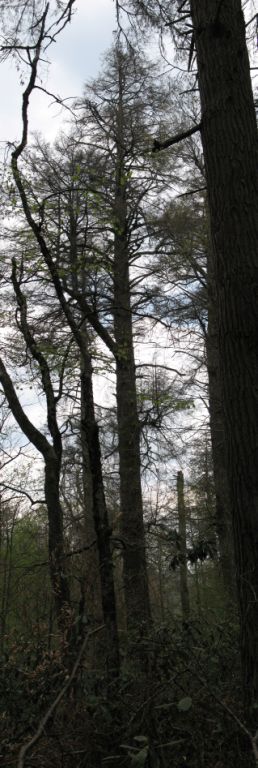
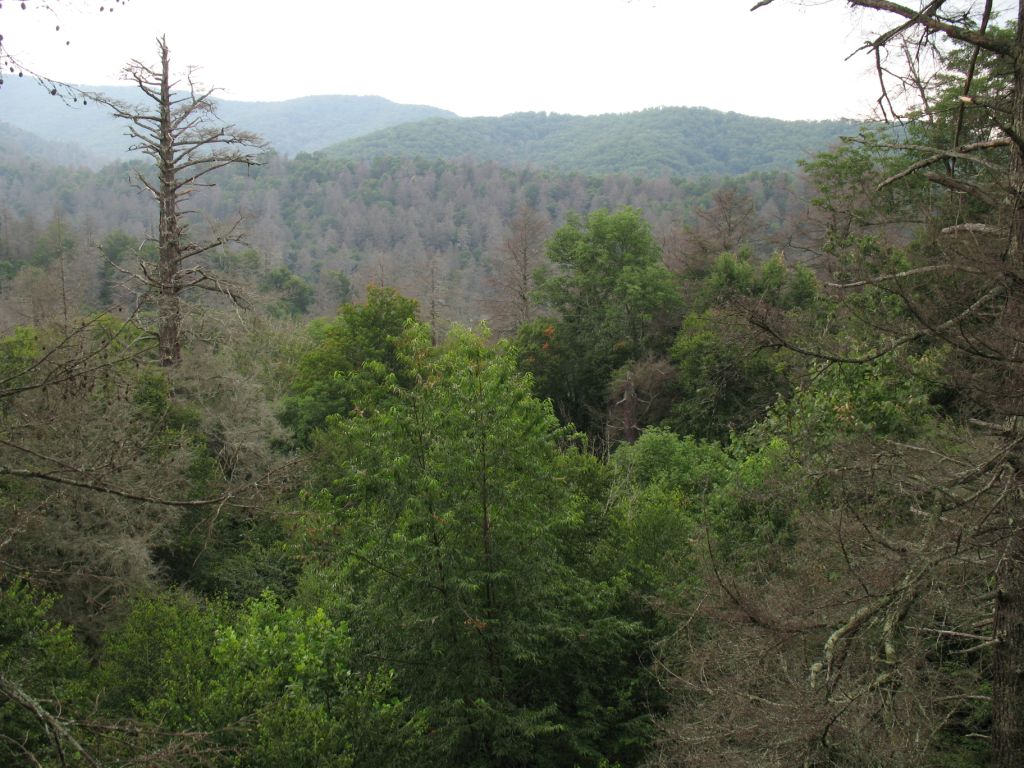
Photos by Will Blozan
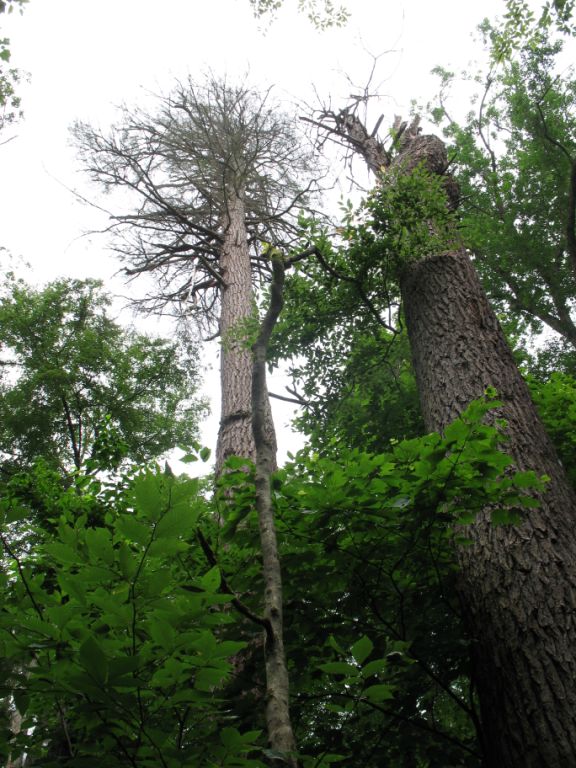
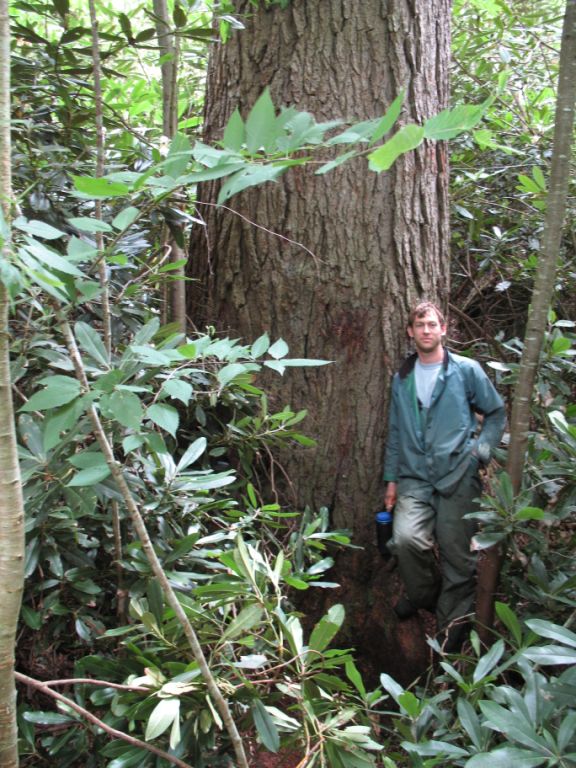
Dan Bryson at base of Triceratops Tree
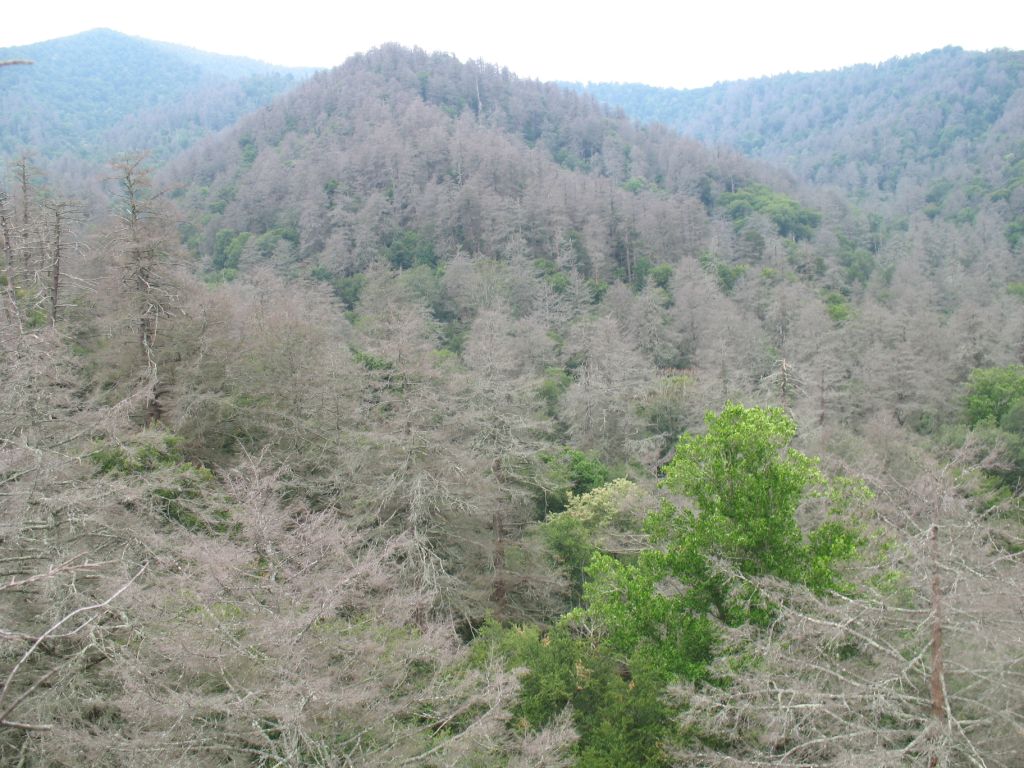
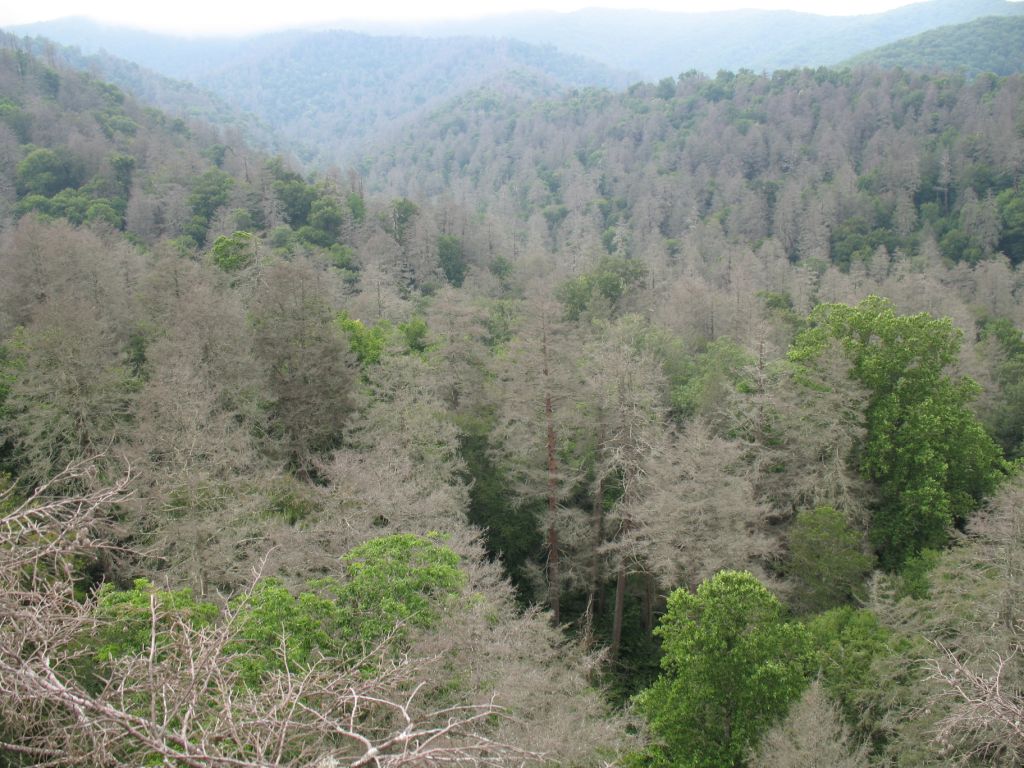
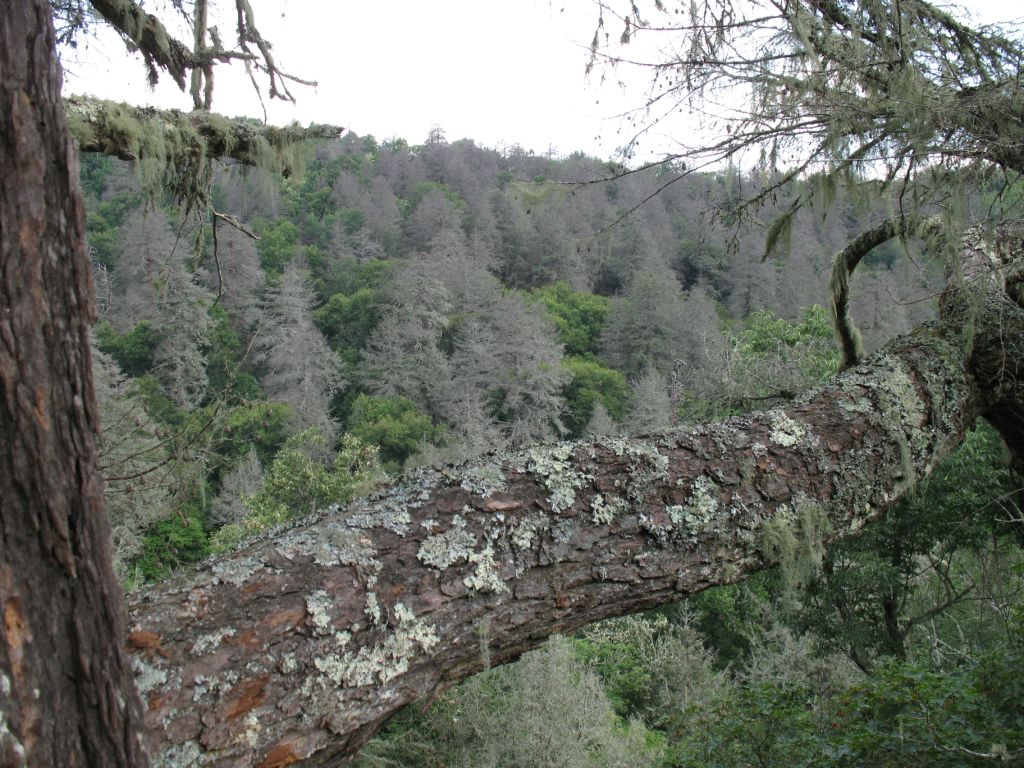
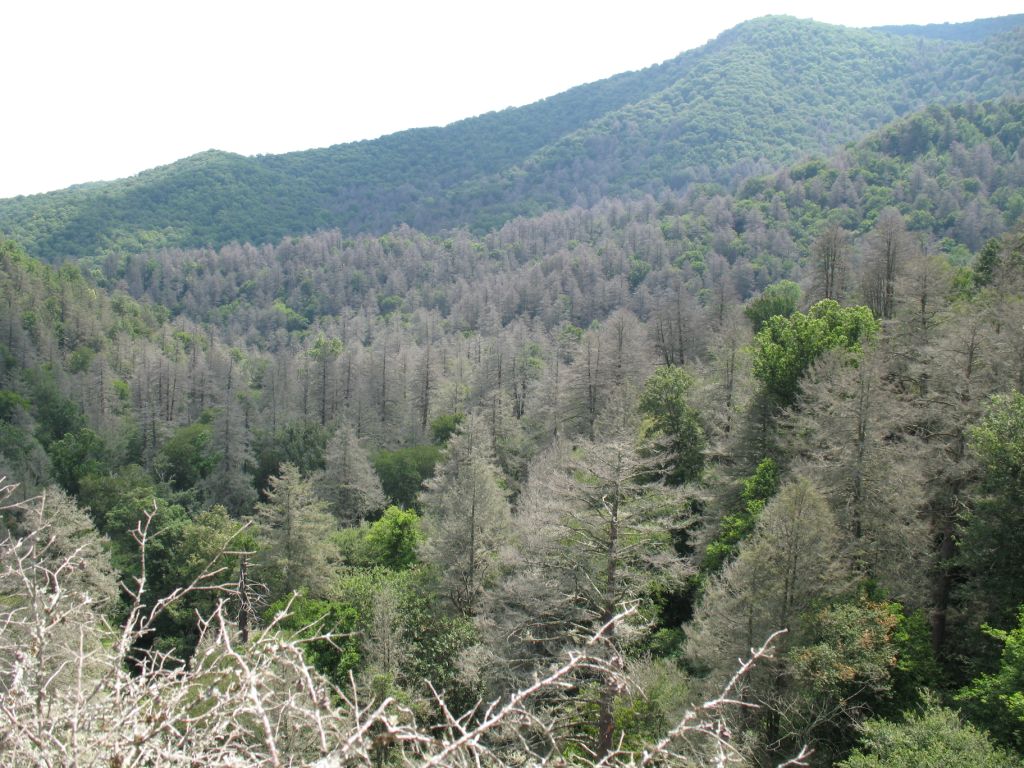
Little Spruce Ridge covered in dead hemlocks.
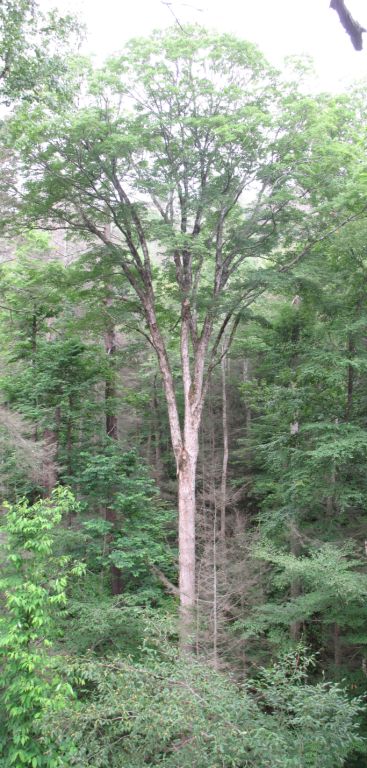
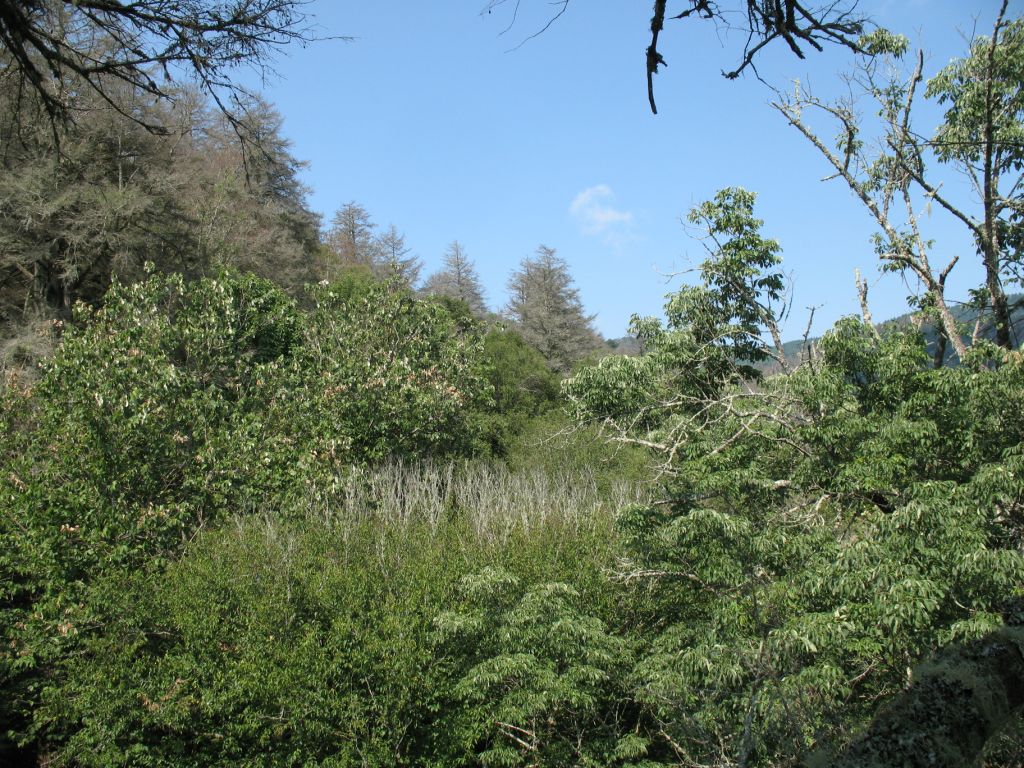
Picture perfect sugar maple near plot
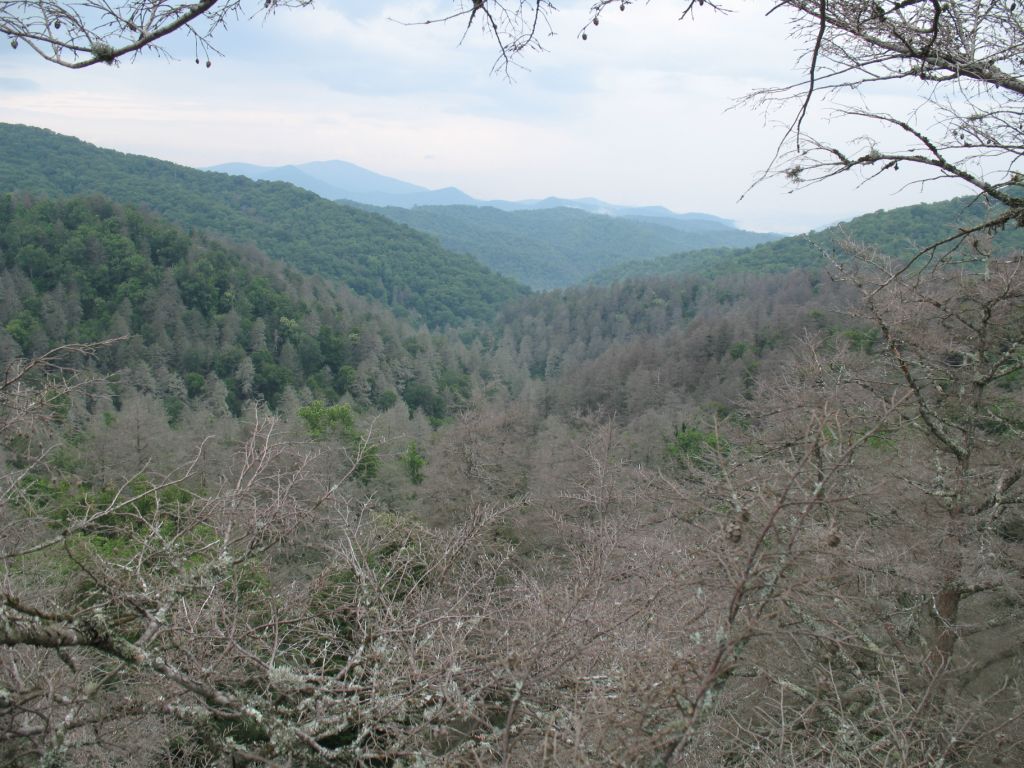
View down Caldwell Fork-Big Fork Ridge on
mid-horizon.
"The Colleague" is named for its association with
another giant hemlock only
~20 feet away named the "Triceratops Tree". The
Triceratops Tree was
discovered in 2000 (?) on a trip with Michael Davie, and
measured to 14'9" X
162.5' tall. It had three huge tops originating from a massive
fusion
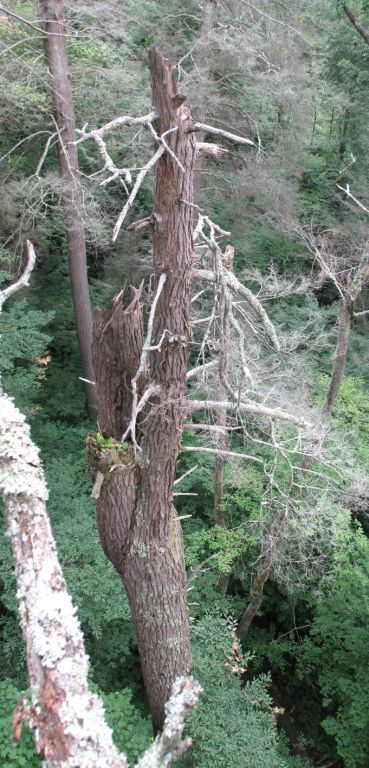
supported by a stout, untapered trunk. Unfortunately this tree
has broken up
and is now just a snag. Laser measurements of the smaller but
still standing
Colleague Hemlock indicated a height of 167', solidly joining
the top 15
club of tall hemlocks. The tape drop was 167.2' and the volume
came out to a
hefty 1317 cubic feet of trunk. So, as an added bonus this tree
joined the
top 15 volume club as well! We can only speculate about the size
of the
Triceratops Tree, as it was clearly a larger specimen. Jess and
I have never
seen such a small spot of earth with so much hemlock volume
anywhere. That
small patch of ground likely contained over 2700 cubic feet of
hemlock! What
a bummer!
Colleague- view of tree next to Triceratops Tree
Colleague- view up Caldwell Fork
Colleague- Triceratops snag
Video shot by Will Blozan. The second is a view
from atop the Colleague Hemlock.
During the entire climb a hawk was watching me and screaming
while flying
from tree to tree. Perhaps it was complaining about the core
sampler
creaking and screeching below (which broke after a few trees ;)
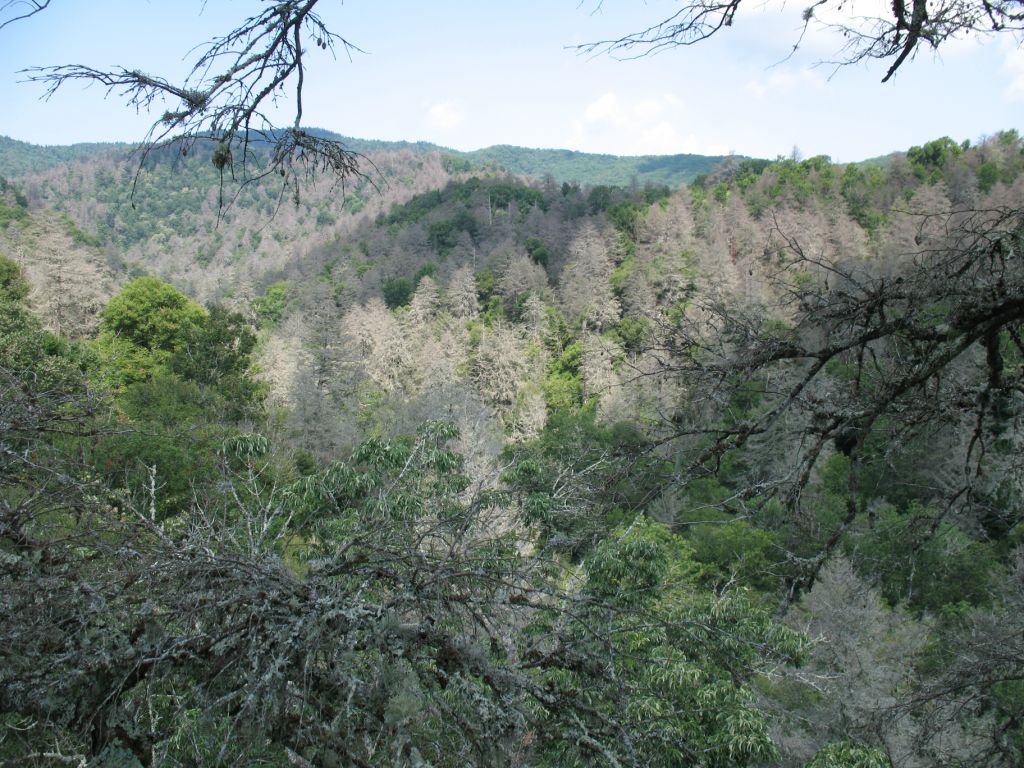
The extreme
emergence of this tree offered an excellent but depressing view
of the vast
hemlock forests of upper Caldwell Fork. As far as could be seen
up the
slopes of Service Ridge and adjacent areas hemlock was the
dominant tree in
nearly pure groves. All of them were already dead or well beyond
any hope of
recovery. The stone-dead Colleague Hemlock was already full of
woodpecker
holes and oozing black stuff from cracks in the bark. I find
solace in the
fact that the Triceratops Tree died a dignified death from
structural
failure and not the damned adelgids.
July 25th
The steady rains of the night finally stopped around 8:00am and
after
gathering up the gear headed back up (soggy) Caldwell Fork to
climb "The
Beast". This tree is so named due to the extreme density of
rhododendron and
downed wood surrounding the tree. It was difficult to even get
to the base
to measure the girth- let alone perform lasered shots to the
trunk for the
tree mapping. We dreaded surveying this tree from the moment of
its
discovery. Just finding a spot to throw a line into the tree to
set the rope
was a challenge.
The Beast- HUGE reiteration base
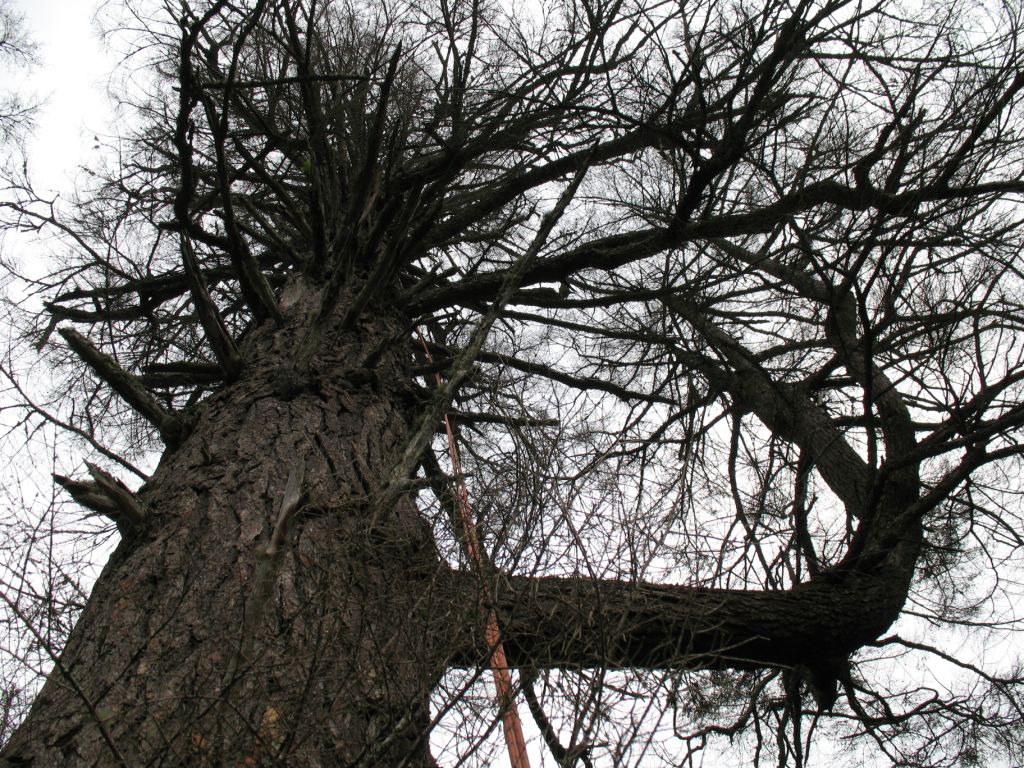
The Beast- Looking up trunk with giant reiteration
The Beast- Moss mat 14' out on reiteration
The Beast- reiteration mass
I settled for a low rope set and as the spitting clouds finally
broke up I
enjoyed an hour of dryness (except my boots, which at this point
were
quickly becoming toxic). The hawk was back, too, alighting in a
nearby tree
to watch the action. The Beast was being surveyed not for height
but for
wood volume. Monocular estimates put the volume at 1350 cubes
with a lasered
height of 151.1'. Not bad; measured volume was 1356 cubes and
height was
151.6'. This tree had a HUGE reiteration that alone scaled 52.7
cubes!
The Beast- stitch
The Beast- View down Little Bald Branch
The Beast- Will Crow at the base
In all, this hideous plot seemed to fly by and was completed in
a record 4
hours! This is partly due to no core samples being pulled. We
got back to
camp early and the thought crossed my mind to re-climb the
Caldwell Colossus
(now dead) to obtain reiteration measurements I forgot to take
on the first
climb. I choose to wait until the other targeted tree was
climbed in case
the throw line got stuck or snapped.
July 26th
This third day was reserved for the climb of the utterly huge
"Caldwell
Giant", a tree Jess and I knew would set a new volume
record. Travel to this
tree was even farther up Caldwell Fork through a gruesome, wet,
slimy
gauntlet of Rhododendron, nettle, seeps, and fallen trees.
However, the sun
did dare to come out so once we arrived we were able to lay out
gear to dry
out during the plot and climb. The hawk was back, screaming and
flying
around the Giant.
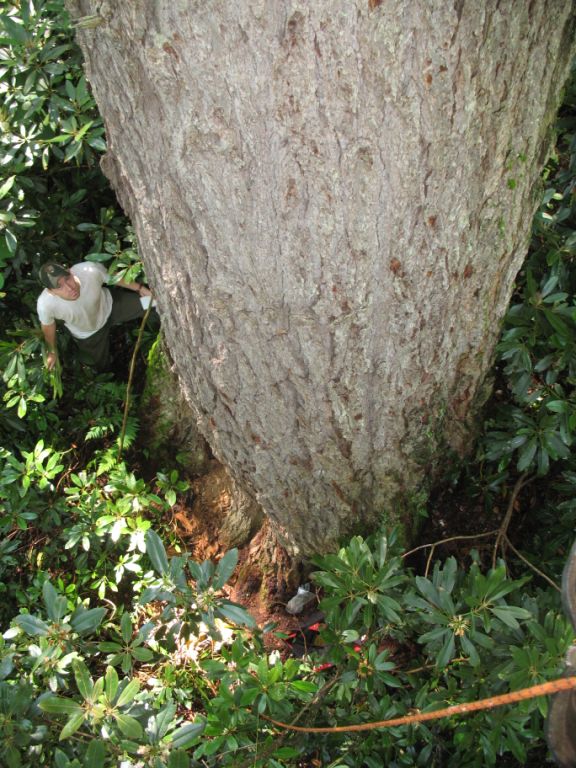
Caldwell Giant- Dan Bryson standing by for scale
Caldwell Giant- Freeze damage on birch and dead
hemlock
Caldwell Giant- Huge branche and ridge across
Caldwell Fork
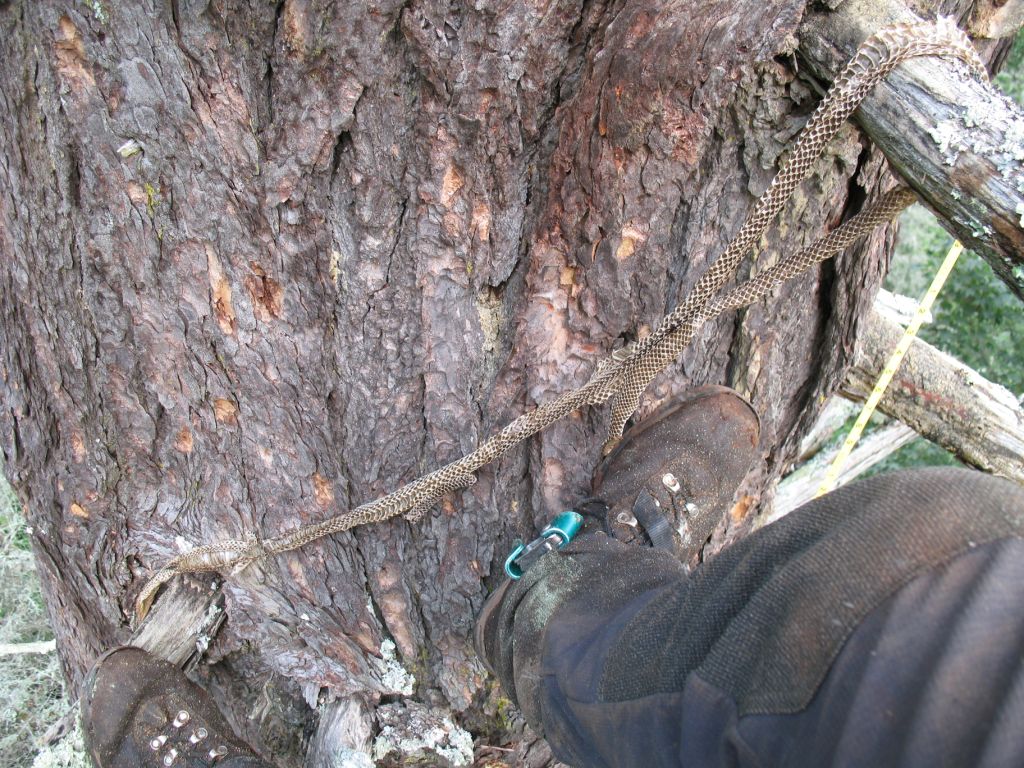
Caldwell Giant- One of three snakeskins in the tree!
Caldwell Giant- Sickening view across Little Bald Branch
to Double Gap Ridge
Caldwell Giant- View up Caldwell Fork to Big Spruce
Ridge
The steep slope behind this tree offered a high, easy set for
the rope at
~95' up. At this height the tree was still 11'4" in girth
(43.3 inches
diameter)! Massive is the word for this tree! The tape drop was
two feet
less than the laser but at 152.1 feet tall this was no shorty.
Volume came
out to a record 1601 cubes! The volume was substantially less
than the
monocular estimate but we expected that due to the poor shots on
the lower
trunk which were obscured by, you guessed it- Rhododendron.
The plot and climb of the Caldwell Giant went well and we were
ahead of
schedule. Before we left the tree I suggested we haul back to
camp, pack up
while I climb the Caldwell Colossus, and head out the six+ miles
to the car.
Considering that our filthy, disgusting clothes and boots were
threatening
to leave with or without us we all agreed. I set a line in the
Colossus
while the others packed up camp. I measured three reiterations
to add to the
trunk volume data collected last year. The tree ended up jumping
from 1385
cubes to 1411 cubes.
We made it out, beat, dirty, and stinky as can be about 6:30 pm
if I recall
correctly. Certain items of clothing were banished to be buried
in the back
of the Jeep but we still needed to ride with the windows down
due to the
asphyxiation potential. It was a seriously grueling day but well
worth
avoiding another day out. I remained sore for four days after
this trip, and
my clothing was washed, bleached, and rewashed three times and
left to bake
in the sun for detox.
Here
are the final rankings of the 15 tallest eastern hemlocks.
Tree
Status
Girth
Height
Volume
Usis
Live
15.75
173.1
1533
Survivor
Dead
11.67
172.1
884
Yuhgi
Dead
9.24
171.7
449
Noland
Mountain
Hemlock
Live
13.74
171.5
1189
Tsali
Dead
13.04
169.8
966
Big
Fork
Tower
Dead
14.25
169.4
1214
Yonaguska
Dead
14.58
168.9
1367
Ellicott's
Rocket
Live
11.82
168.8
778
East
Fork Spire
Dead
11.21
168.7
639
Nellie
Cove Tall
Dead
10.5
168.4
585
Crow's
Nest
Dead
13.17
167.3
1048
Hurricane
Creek Hemlock
Live
15.42
167.3
1340
The
Colleague
Dead
15.13
167.2
1317
Jim
Branch Giant
Live
13.08
166.7
1188
Shanty
Branch
Tower
Dead
12.37
166.1
912
And here are the 15 largest hemlocks
Tree
Status
Girth
Height
Volume
Caldwell
Giant
Dead
19.10
152.1
1601
Laurel
Branch Leviathan
Live
18.34
156.3
1585
Cheoah
Live
16.00
158.7
1564
Usis
Live
15.75
173.1
1533
Caldwell
Colossus
Dead
16.83
159.7
1411
Yonaguska
Dead
14.58
168.9
1367
The
Beast
Dead
15.87
151.5
1356
Double
Gap Hemlock
Dead
14.75
164.8
1348
Dunn
Creek Hemlock
Live
18.07
143.3
1344
Hurricane
Creek Hemlock
Live
15.42
167.3
1340
Trailside
Giant
Dead
16.39
154.3
1338
The
Colleague
Dead
15.13
167.2
1317
Headless
Giant
Dead
15.81
120.3
1307
Buckeye
Creek Hemlock
Live?
15.56
146.8
1307
Long
Branch
Live
16.00
143.6
1294
On just these trees we measured (no repeats):
Total
surveyed heights=
4,188.4
ft
Total
surveyed reiterations=
1,604.6
ft
Total
bifurcation lengths=
829.6
ft
Total
path length measured=
6,622.6
ft
Total
surveyed volume=
30,860.0
ft3
Total
reiteration volume=
491.9
ft3
Total
volume measured=
31,351.9
ft3
All those trees combined don't even add up to a medium sized
giant sequoia,
and are nearly 8000 cubes shy of the smallest giant sequoia in
Dr. Van
Pelt's book, "Forest Giants of the Pacific Coast"!
However, the Caldwell
Giant can claim to be larger than some of the largest specimens
in his book
of Englemann spruce and Pacific silver fir!
But without a moments doubt, Jess and I have hereby documented
superlative
specimens of eastern hemlock that will not been seen again for
centuries- if
ever. I think we can solidly say that in this modern time
snapshot of the
species, eastern hemlock, by volume, is the undisputed evergreen
conifer
champion of the east. I would doubt that historically eastern
white pine or
loblolly pine could reach 1600 cubic feet of wood volume. As
trunk volume
records stand today, eastern white pine has been documented to
reach 1127
cubes and loblolly pine 1298 cubes- and these are likely far
outliers. But
in contrast to eastern hemlock, we have already lost the finest
specimens of
the eastern pines.
Will Blozan
President, Eastern Native Tree Society
President, Appalachian Arborists, Inc.
Re:
Tsuga Search Finale
Lee
E. Frelich
Aug
09, 2007 18:18 PDT
Will,
Jess:
Great job! However, very sad that only a few hemlocks are being
kept alive
by artificial methods.
We could use some of your sogginess. Our hemlocks are dying in
large
numbers as well due to the effects of multiple droughts--a
severe drought
last summer, one this spring and a third one that has developed
in the last
month. Some areas are now in the extreme drought category,
including the
hemlock forests in the Porcupine Mountains and Sylvania
Wilderness areas.
Maple and birch forests are being hit even harder because of the
European
earthworm invasion that strips the duff, leaving the soil
without
insulation so that it gets much warmer during the summer, and
lack of
mycorrhizae that used to live in the leaf litter, that we think
is causing
P deficiency. You can now see dead trees by the millions
throughout Upper
Michigan, Wisconsin and Minnesota. I wonder if any hemlock will
be here by
the time the adelgid arrives--perhaps some will survive in areas
with silty
soils or seepages. The forest in the Porkies has the best chance
of
surviving because many of the soils are silty, and the lake
effect snow
guarantees a recharge of the soil water each spring.
Lee
RE:
Tsuga Search Finale
Will
Blozan
Aug
15, 2007 23:36 PDT
Matthew,
It is alive, but no longer has the highest living foliage of
eastern
hemlock. This title will go to the Noland Mountain Hemlock
(171.5') which
will be treated with Safari in the coming weeks. It is the only
hemlock over
170' with a living top.
Will
-----Original Message-----
From: Matthew Hannum [mailto:duskd-@earthlink.net]
Sent: Wednesday, August 15, 2007 6:51 PM
To: ENTST-@topica.com
Subject: RE: Tsuga Search Finale
WOW!!
Very impressive work! I am glad that this magnificent species
has now
been documented before the adelgids do their grim deed.
Is the USIS tree alive or dead? Last I checked the article on
the
website, the table at the end lists it as living in one place
and dead
in the other...