 Unusual Forests
On March 14, 2010 The Eastern Native Tree Society and Western Native Tree Society switched from discussion lists on Google Groups to a new discussion list in a Bulletin Board format at: http://www.ents-bbs.org/index.php Posts made since the inception of the BBS on march 14, 2010 will be sorted and archived on the BBS. Click on the link above to go to the equivalent section on the new BBS. This website will continue to serve as a front end for the ENTS and WNTS groups. It will continue to serve as a repository of older posts, and will serve as the host site for special projects and features that are not well suited for a BBS format. Please visit the BBs for the latest information and trip reports. Unusual Forests by Edward Forrest Frank Places in which the trees are not spectacular, but represent an unusual assemblage or exhibit unusual character are something I feel is as important to document as are the big trees we measure. Other examples, such as the the rock elm forest in Minnesota, are also worth documenting. We may not know if all of the examples included in this section are significant in a broader context, but we will never know unless we catalogue and document these finds.Dr. Lee Frelich wrote (December 6, 2008): "I think unusual forests are important because they may have covered millions of acres in the past, and may again in the future. For example the elm forest of Minnesota which probably now totals only a few hundred acres, covered the southern half of MN, WI, and most of IA, IL and IN 11,000 years before present. It may also be the forest of the future when the climate changes." Forests
in this section include:
2) Mixed Conditions: We should also consider those forests such as are growing in a mixed condition like trees in swamp setting or trees in desert setting. These are not what we would normally consider a forest, but they are a vital part of the ecosystem. The old growth post oak systems in the cross- timbers areas of Oklahoma and Texas are a good example of this type of assemblage.
3) Forests with character:
This is a somewhat subjective category, but a forest segment with these
characteristics would likely be recognized by a wide number of people. The
term "aged with adversity" has been used and this is
really the focus of this characteristic. Don Bertolette said, "some
of the oldest trees of several species that come to mind (foxtail pine in
the Sierra Nevada's, bristlecone pine in the Sierras and White Mtns.,
western juniper) are growing on relatively depauperate sites, in
environmentally extreme climatic conditions." So we have the concept
of trees that have character because they have been aged by adversity.
This would include many of the stunted forests growing under harsh
environmental conditions. The age of these trees may not be easily
apparent hidden by their unusual form, and certainly they are not large
for the species, but they do have character.
Locations
General |
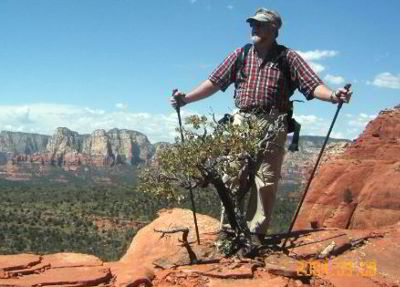 "Forest" in Sedona Canyon, AZ
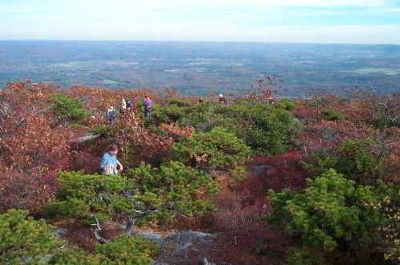 Stunted pines atop Mt. Everett, MA